Monday, August 12, 2013

Schwerin to Berlin (Germany Part 10)

(Start Reading at Part 1)

The next morning we walked through the busy city of Schwerin, only to find that the castle is closed on Mondays.   This picture, less lovely than the view from the other side across the water, is typical of nearly every historical building we saw in Germany-- perpetually under restoration.  We were disappointed but not devastated-- we had trailed through many rooms of old portraits, old clocks and tiled stoves, old canopy beds and gilded woodwork and we were content to spend time wandering the gardens.


There we had the lovely experience of seeing a swan family with seven cygnets.  They really are gawky and homely babies-- the proverbial "ugly ducklings".


We found a very nice "portrait" of John by the shore of the lake.


Ingrid and Bill

We caught the noon train to Berlin and arrived a few hours later, disgorged into the frenzied environs of Alexanderplatz-- all of us hot, tired and dazed.  Tagging behind Ingrid and Bill we walked to our Ibis hotel-- a walk that seemed endless to me as I dodged pedestrians and more bicyclists than  I have ever seen anywhere.  We did the same walk several times in the next few days and I realized it was only about 10 minutes.  

Our hotel was an Ibis-- a chain with hotels across Europe-- we stayed at an Ibis in Budapest.  Relatively inexpensive, clean, comfortable, attractive and with air conditioning!  It was the perfect place for our Berlin stay.  Breakfast was 10 euros extra but it was simply superb-- a buffet of croissants, breads, meats, cheeses, fruits, cereals, juices, eggs, and all manner of coffee and drinks.  Our breakfasts were always great but this one topped the list.  


Continue to Part 11

Sunday, August 11, 2013

Ludwigslust to Schwerin (Germany Part 9)

(Start Reading at Part 1)

Lugwigslust is a relatively young town and has an interesting history.  A Prince Ludwig built a hunting lodge near the small hamlet of Klenow, then established himself there and renamed the town "Ludwig's Joy".  The hunting lodge developed into the schloss you see in the picture, surrounded by acres and acres of gardens, paths, bridges, fountains and all the elements of beauty that can be afforded by self-indulgent aristocrats living off the sweat of their peasants.

What we did not learn from our guidebooks or from tourist information about Ludwigslust is that it was the location of a small concentration camp called Wobbelin.  The camp was only built in 1944 and it was originally intended to house U.S. prisoners of war.  In 1945 the SS enlarged the camp as a destination for  prisoners who were being transferred to prevent their liberation by the Allies as the war came to a close.  On May 2 1945 American military units discovered the camp with the bodies of 1000 starved prisoners and 4000, still alive but in deplorable conditions.  The Americans forced the citizens of Ludswiglust  to tour the camp and assist in the burial of the dead.   There is a local memorial that we were not told of and did not see.


On the grounds of Ludwigslust Schloss.  

An Insect Hotel
This is one of the peculiarly German things that I had seen before but didn't photograph until I saw it again on the last day.  Tidy gardens, lawns and lack of dead wood mean less habitat for bees, spiders and ladybugs and these structures are designed to provide a home for various beneficial insets and pollinators.   While I say German, the internet tells me that they have spread across Europe and are now beginning to be created in the U.S. as well.


This was our our last lunch-- not a very picturesque location but the most vivacious waitress ever and as always good beer and good food.  

  
Not long before we reached Schwerin we passed through the very nice village of Mirow.  This was of particular interest because John's paternal grandmother was a Mirow and Mirows and Langhans had intermarried for many years in the villages around Rotzeburg.  While I have never found a direct connection to a Mirow from Mirow, I know that place names predate surnames and it is reasonable to assume that the first Mirows may have come from this village.  
Schwerin Schloss
Our first look at the Schwerin Schloss came from across the water as we rode on a busy lakeside trail toward the city.  Very Cinderella's castle!  We all took many pictures and looked forward to seeing more the next day.  In the meantime, we pushed on to our last hotel, the Hotel am Hauptbahnhof.


The hotel was right across from the train station-- very convenient for our trip to Berlin the next day but very noisy as well.  Train stations have associated bus and trolley lines as well as many people coming and going and our rooms were on the street but the bustle was not unpleasant.  The hotel was not nearly as upscale as some we had stayed at and the owners were much enamored of a red and yellow color scheme that went far beyond the obvious.  The dishes, napkins, flower pots, flowers, pitchers, bedspreads, lamp shades, etc.  Everything was either red and yellow and to my eyes it was a bit lurid but someone must have loved it.  Our window is the wide open one just to the left of the balcony.
Continue to Part 10

Vielank to Lugwigslust (Germany Part 8)

(Start Reading at Part 1)
Leaving Vielank the next morning our route took us through Ruterberg, a village that had a unique situation during the Iron Curtain years.  Situated on the east bank of the Elbe, the village was occupied by the British at the end of the War.  The bridge that had been there was obliterated in battle, the East Germans fenced off the village and it was thus completely isolated from both East and West.  There is a local museum but it was closed on the day we rode through-- there is nothing I can find on the internet.  It is hard to imagine how the inhabitants got through the years of division.  I am thinking the reason I can't find anything is that I don't know how to make the umlaut?


Our next stop was Domitz, site of a very well preserved lowland fortress.  We spent some time exploring the ramparts and the museum there.  Aside from the fortress Domitz is an example of an East German town that feels a long way from vibrant.  Looking for lunch we found a place that appeared open.  An elegant old man appeared and told us that we could get only drinks-- "his womenfolk were away."  He told us that there were two cafes in either direction but everything we found was closed.  Finally in an old department store that has become a galleria of sorts we were able to get wurst and while I had been avoiding meat for most of the trip, I had little option but to eat it or go hungry.  


Part of our ride on this day took us past some beautiful sand dunes.  The idea of sand dunes in Germany is disconcerting but this was not the only time we had encountered them.  These were the most photogenic, however.
  

This is another picture in the same area and it shows the sandy track along which we were riding.  Our bikes handled this stuff pretty well but it was slow going and one did become mired in sand every so often.

This picture, taken 39 minutes later, shows the great variety of riding we did, throughout the trip and in a single day.  


This is one of the kookier things we saw that day.  A man and his wife pulling their camper with their tractor.  She had a comfy seat up behind her husband and although it cannot be seen in the photo, there was a small stuffed bear sitting beside her.  They stopped us to ask for directions to a campground!  


A note regarding my handlebars.  All of our bikes had these "butterfly" handlebars and I had high hopes for the configuration, very common in Europe but almost unseen in the U.S.  My "Achilles Heel" is (are?) my hands which get numb and sore, and I am always looking for a solution.  Sadly, pretty as this purple and black tape was, my hands hurt at all points on the handlebars.  I was much happier with the upright bars on Ingrid's "comfort" bicycle and on the bicycles we rented later in Berlin.  
.


Also a note regarding the type of beds we found in every hotel but the Ibis in Berlin.  The pillows were large, square and very squishy.  The comforters and mattresses were individual and in almost every instance pure white.  Sadly it was uncharacteristically hot while we were there and the comforter not what we needed.  I tended to roll it up like a body pillow and sleep next to it rather than under it.  The little brown bits on the pillows are chocolate but sometimes we got small packages of gummy bears.  
Our hotel for the night was in Ludwigslust (Ludwig's Pleasure) and it was definitely the swankiest of the tour.  Called the Erbprinz Hotel, it was all gleaming glass and chrome and we were able to pay for internet after several days without.  
Continue to Part 9

Saturday, August 10, 2013

Gulstorf to Vielank (Germany Part 7)

(Start Reading at Part 1)

As we rode along the bike path in a rural area we saw a sign for a trailside cafe.  It was a very informal arrangement-- we stopped, took a table and the proprietress said she had wurst and potato salad.  We all had her homemade "apfel schorle"-- basically apple juice with a bit of fizzy water.  She was friendly and chatty and offered to take a picture of the group.  At the end she said that she had no set prices and that we should pay her what we thought it was worth-- this caused some hemming and hawing and she then told us that the potatoes cost her so much and the wursts were expensive because she had to go over the river in the ferry to get them, etc.  So we began forking over euros and hoped she was pleased.  Bill figured out that she was unlicensed and by not posting or charging specific prices she could stay on the right side of the authorities.


As we ended the day we had one of our very few extended periods of road riding-- it was not hair raising but the cars in Germany go very fast and there was no riding double.  We passed two of these grisly reminders of possible consequences-- one of them had a sign that said "This Could be You!".  Reminiscent of the ghost bikes we have seen in the United States.


This is a ghost bike that we saw in Idaho on our ride from Oregon to New Hampshire.  The first ghost bikes were established in Missouri but the ghost bike web site says there are now over 500 world wide.

Church in Tripkau

The half timbered church in Tripkau "is worth a trip" as they say in their brochure (in English and German).  It is beautifully situated in a large open space and beautifully proportioned.  Inside it is a shock.  


The interior of the church is unique with this cross motif that completely covers the ceiling and walls.  A much nicer professional picture is here http://www.flickr.com/photos/pe_ha45/430587678/

Our home for the evening was Vielank, location of a destination brewery, restaurant and hotel.  They had lots of good beer, several flavors of delicious soda and excellent food.  I was slightly grumpy because our rooms were in a building separate from the restaurant facility-- we had to ride our bikes over, walk back, schlep our luggage, walk back for dinner, walk, schlep, walk, ride, etc.  but goodness knows I had little enough to complain about on this trip-- I had to find something!


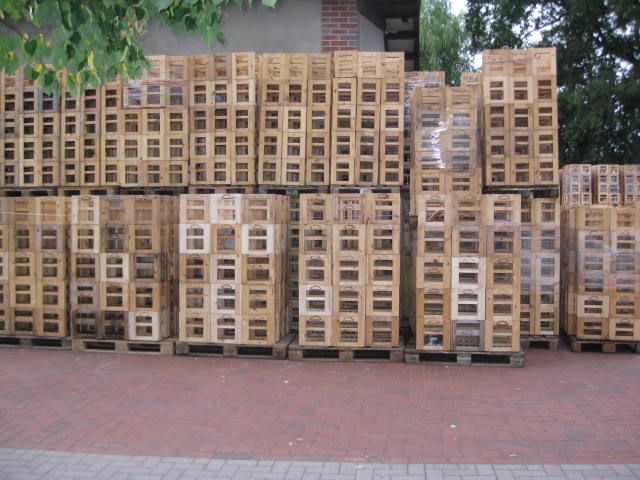
Crates at the Vielanker Brauhaus
Liz got a healthful salad at the Brauhaus


Continue to Part 8

Friday, August 9, 2013

Boisenburg to Gulstorf (Germany Part 6)

(Start Reading at Part 1)

Soon after leaving Boisenburg we rode down to a dike that serves as flood control along the Elbe.  The Elbe River Basin is the fourth largest in Europe.  In Northern Germany it flows through a large fertile plain that is subject to periodic flooding.  Floods since 2000 have been the worst in centuries and the European Union has expended huge sums of money to build flood barrier like that in the picture.  Sand and sandbags to the left of the picture are left from the June 2013 flood that topped this dike in some places.


We also saw piles of sandbags near houses and huge sandbag caches on the outside of the dike.


This is another view showing standing water left from the June flood.


I got a kick out of the logo on the toilets-- the workers had to hold back the Elbe but they did not have to restrain themselves.  


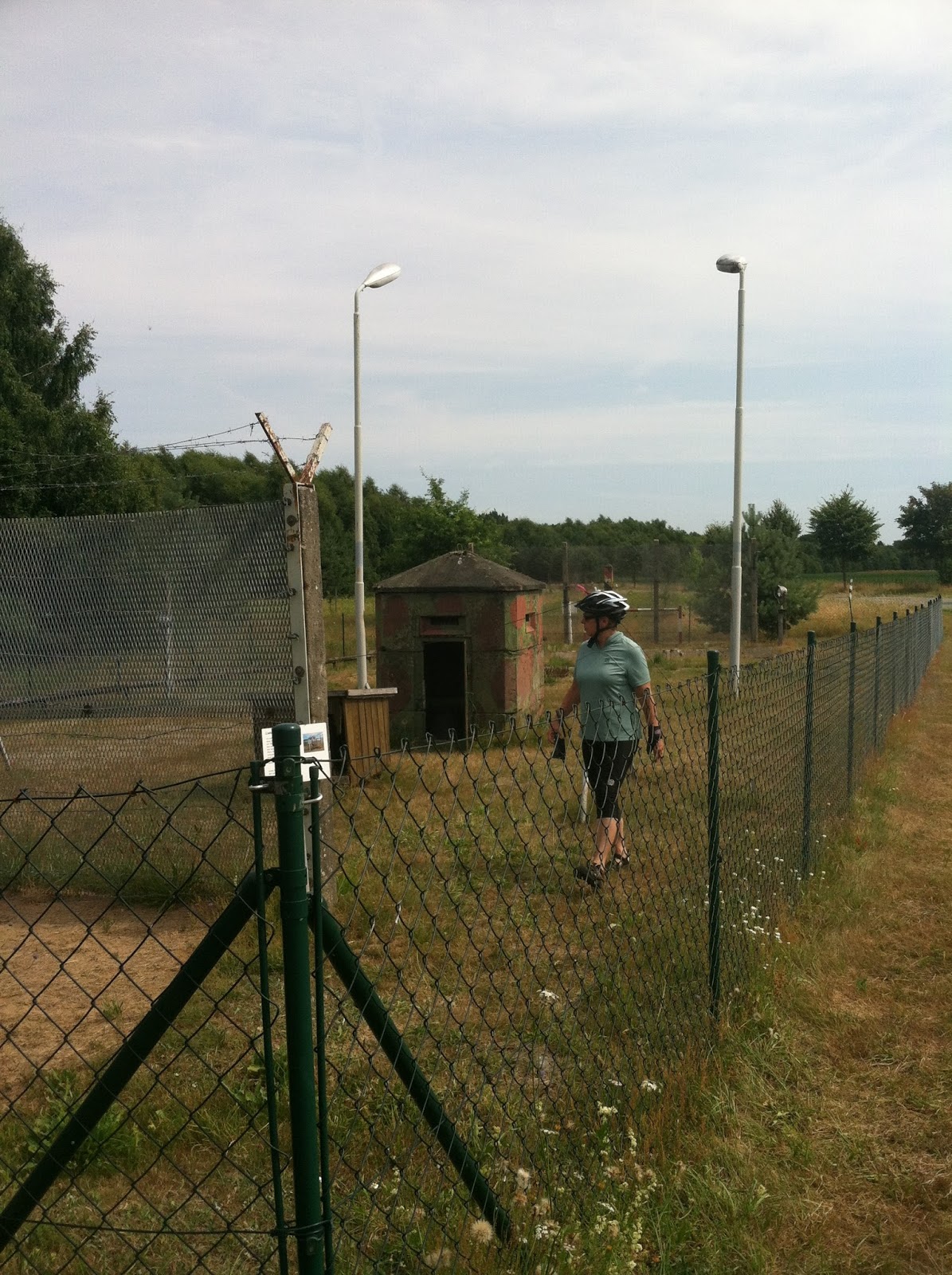
This section of the Elbe served as the border between East and West and was heavily secured.  We passed several towers like this one-- much taller than the little bunker we saw the day before.


This is a watch tower that has been turned into a private residence.

Escape attempts were common but rarely successful.  In September of 1964 14 people, 11 of whom were children, escaped in a refrigerated truck hidden under the carcasses of slaughtered pigs.  In 1989 eight people escaped in a home made hot air balloon.   Our Berlin guide told us of an office worker whose building was adjacent to the Berlin Wall.  He and his wife and two children managed to escape by sliding down a rope from the top of the building, over the "death zone" and into West Berlin.   Current unofficial estimates are that 75,000 people tried unsuccessfully to escape and 1100 died or were killed in the attempt.  Those not killed at the time were executed, imprisoned or exiled to the East.

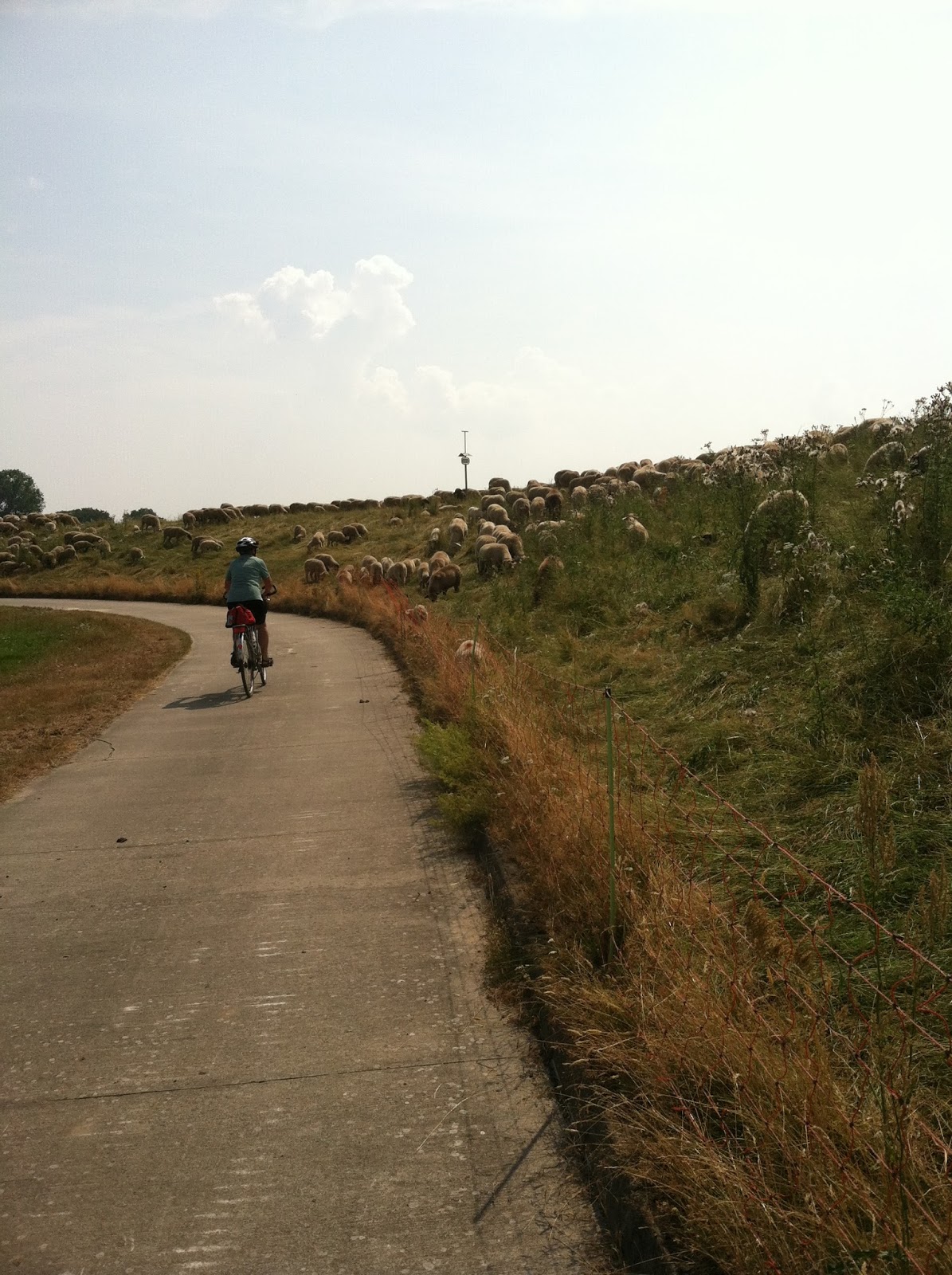
Sheep are used to "mow" the sides of the dike-- even had we not seen flocks like this one, the evidence on the pathway was abundant.


Later we saw a large flock being moved.  There were four dogs, none of which looked like the kind of border collies familiar to us but all very skilled at their jobs.

Because the Elbe served as the border there are few bridges and most traffic crosses on ferries.  We took a ferry back onto the West side visiting the village of New Bleckede.


The sign at the crossing is an example of the fact that the border did not open all at once.  The date is six days later than on the sign we saw when first passing into the East.  The crossing was fun and slightly suspenseful.  This huge truck appeared at the ferry slip not knowing whether he would be loaded and knowing that the ferry would save him 70 kilometers of driving.  He was permitted on and took of most of the available vehicle space.


The ferry also did a booming business in tractors and hay bales.


An empty tractor and trailer loaded when we disembarked and this one arrived as we waited for our return trip.  

Bleckede was a town full of charming old house like this very tipsy one.  


I was charmed, also, by this fellow peering over a wall.  

Our night was spent in one of the huge old barns typical of the area.  It had been beautifully  renovated as a hotel intended to be accessible to the handicapped.  The rooms and bathrooms were huge-- the shower had no enclosure, just a drain in the floor-- designed to be used by someone in a wheelchair.   Money had run out, however, so progress was stalled-- most apparently because the entrance to the elevator was blocked by a piece of plywood.  We were told it was out of order but it was pretty clear that it didn't even exist.  

In the meantime they were hosting a large number of ambulatory senior citizens.  They were people who lived on their own but had gotten together for a multi-day excursion.  Because they felt it was too hot to be sightseeing, they were playing cards on the patio.  About four they started with coffee and "kuchen" and about six moved on to beer.  My friend Ingrid said that Germans at home typically eat a full hot lunch, coffee and cake in the afternoon and cold meat, cheese and bread for dinner.  

It was clear that the place had been located directly on the border patrol road.  The road in front of the hotel was paved but dead ended shortly thereafter trailing off into the kind of divided concrete blocks that had been used on the border.  

There was a great stork nest nearby.  Liz had a better camera and got better pictures of storks than I did.  I will try to swap this one out eventually.  Storks are considered good luck and many nesting poles like this one are erected for them.  The sitting storks we saw were probably young ones, waiting for their parents to bring food.  When a nest appears empty it is often because they are deep enough to hide the birds when they are lying down.  


This is an example of German commitment to solar power.  Completely covered roofs like this one are a common sight.  
Continue to Part 7

Thursday, August 8, 2013

Busy in Boisenburg (Germany Part 5)

(Start Reading at Part 1)

The day began with an idyllic ride on this forest road-- cars were apparently not excluded but none passed us for hours.  I knew we were in the area of the east west border and wondered if this paved road was part of the system but was never clear on that.  When we left the forest, we were in an agricultural area, then came upon an open air museum with all the elements of  border fence security as it was fully developed by the 1980's.

A five kilometer border zone was first established in 1952.  Persons living close to the border or deemed politically unreliable were moved out of this zone but farming was continued where possible.  Persons authorized to enter the zone were strictly controlled and were expected to contribute to border security.  In the beginning there was no fence, just gates at crossroads.  As the system developed a signal fence was installed.  The fence included strands of electrified wire that activated an alarm if cut or pulled.


Layers of complexity were added over the years.  Mining of the borders began in 1966 but mines were removed in 1984 in the face of international condemnation.  "Hedgehog" strips were designed to ruin vehicle tires, devices were added to the fences to shoot shrapnel, dogs on long runs patrolled some sections and after the mines were removed, the border included and anti-vehicle ditch that sloped down and ended in a brick or concrete wall.  


This type of small observation tower was common but has mostly disappeared.  It was designed for two guards, had rifle slots and a can toilet.  


Once we learned to recognize the distinctive type of fence wire used in the border, we sometimes saw recycled bits like this.  


We several times cycled on concrete paths but didn't realize until later that they were remnants of the old border road.   


Our destination for the day was Boizenburg, a town just a few kilometers inside the east west border.  Fittingly, the hotel where we stayed was renovated from a facility that housed members of the Stasi, the "Ministry for State Security."  Our ride was short enough that we saddled up after a short break and rode into the city itself.  There we got our first view of the Elbe since Hamburg-- a pastoral scene wildly different from the forest of cranes and ships we had seen in the harbor.  


While John explored the town with Ingrid and Bill, I rode off with Liz and Rick to look at another outdoor museum.  This was "Checkpoint Harry", an observation tower and associated building that has now been turned into a restaurant by that same name.  


Our hotel restaurant featured many dishes made with kangaroo meat but none of us availed ourselves of it.  They also keep ostriches-- not for eating but for eggs and we were given complimentary glasses of ostrich egg liqueur when our meal was finished.   It was lovely and sweet and went down very well.  

Continue to Part 6