Friday, August 9, 2013

Boisenburg to Gulstorf (Germany Part 6)

(Start Reading at Part 1)

Soon after leaving Boisenburg we rode down to a dike that serves as flood control along the Elbe.  The Elbe River Basin is the fourth largest in Europe.  In Northern Germany it flows through a large fertile plain that is subject to periodic flooding.  Floods since 2000 have been the worst in centuries and the European Union has expended huge sums of money to build flood barrier like that in the picture.  Sand and sandbags to the left of the picture are left from the June 2013 flood that topped this dike in some places.


We also saw piles of sandbags near houses and huge sandbag caches on the outside of the dike.


This is another view showing standing water left from the June flood.


I got a kick out of the logo on the toilets-- the workers had to hold back the Elbe but they did not have to restrain themselves.  


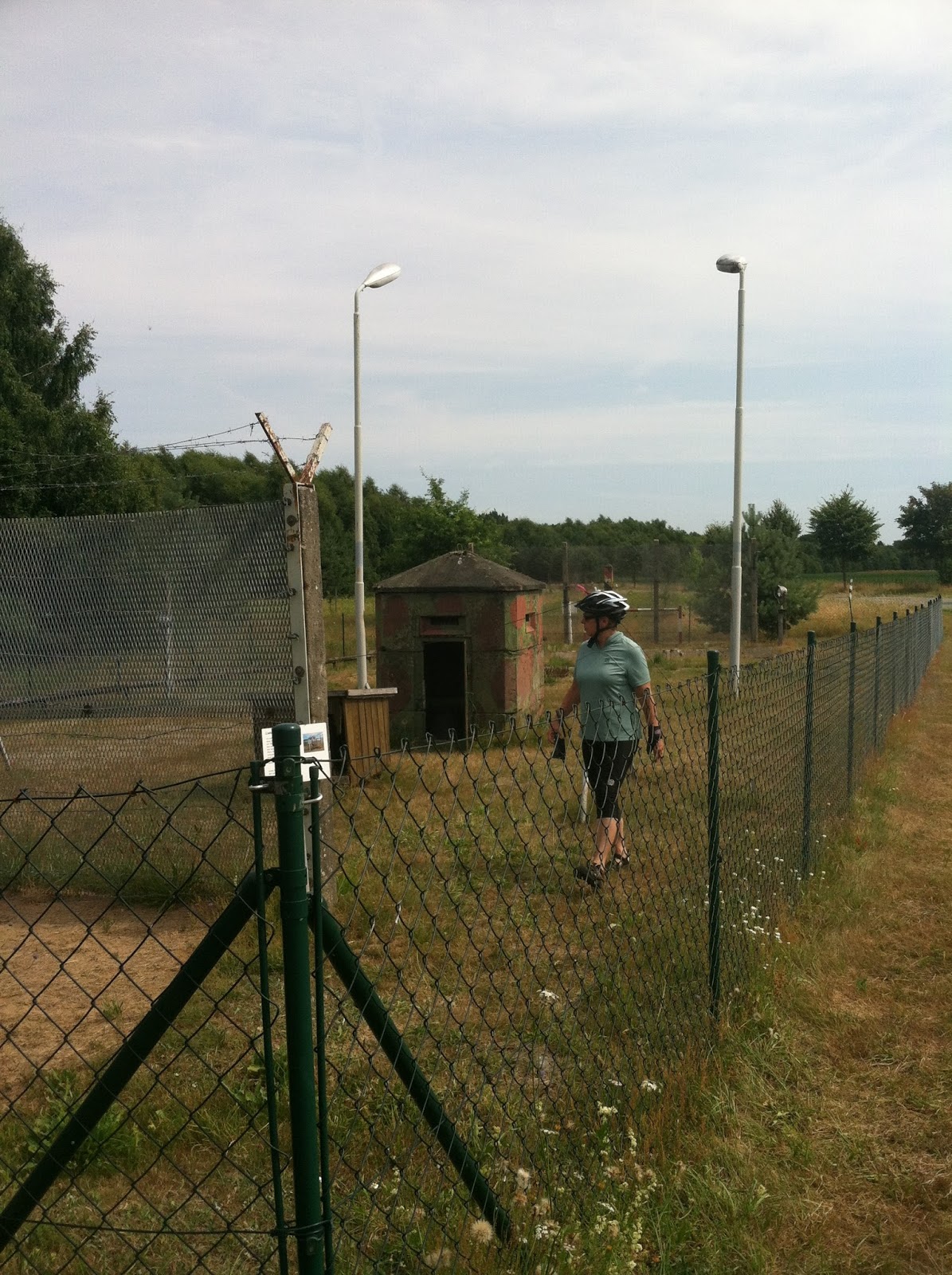
This section of the Elbe served as the border between East and West and was heavily secured.  We passed several towers like this one-- much taller than the little bunker we saw the day before.


This is a watch tower that has been turned into a private residence.

Escape attempts were common but rarely successful.  In September of 1964 14 people, 11 of whom were children, escaped in a refrigerated truck hidden under the carcasses of slaughtered pigs.  In 1989 eight people escaped in a home made hot air balloon.   Our Berlin guide told us of an office worker whose building was adjacent to the Berlin Wall.  He and his wife and two children managed to escape by sliding down a rope from the top of the building, over the "death zone" and into West Berlin.   Current unofficial estimates are that 75,000 people tried unsuccessfully to escape and 1100 died or were killed in the attempt.  Those not killed at the time were executed, imprisoned or exiled to the East.

Sheep are used to "mow" the sides of the dike-- even had we not seen flocks like this one, the evidence on the pathway was abundant.
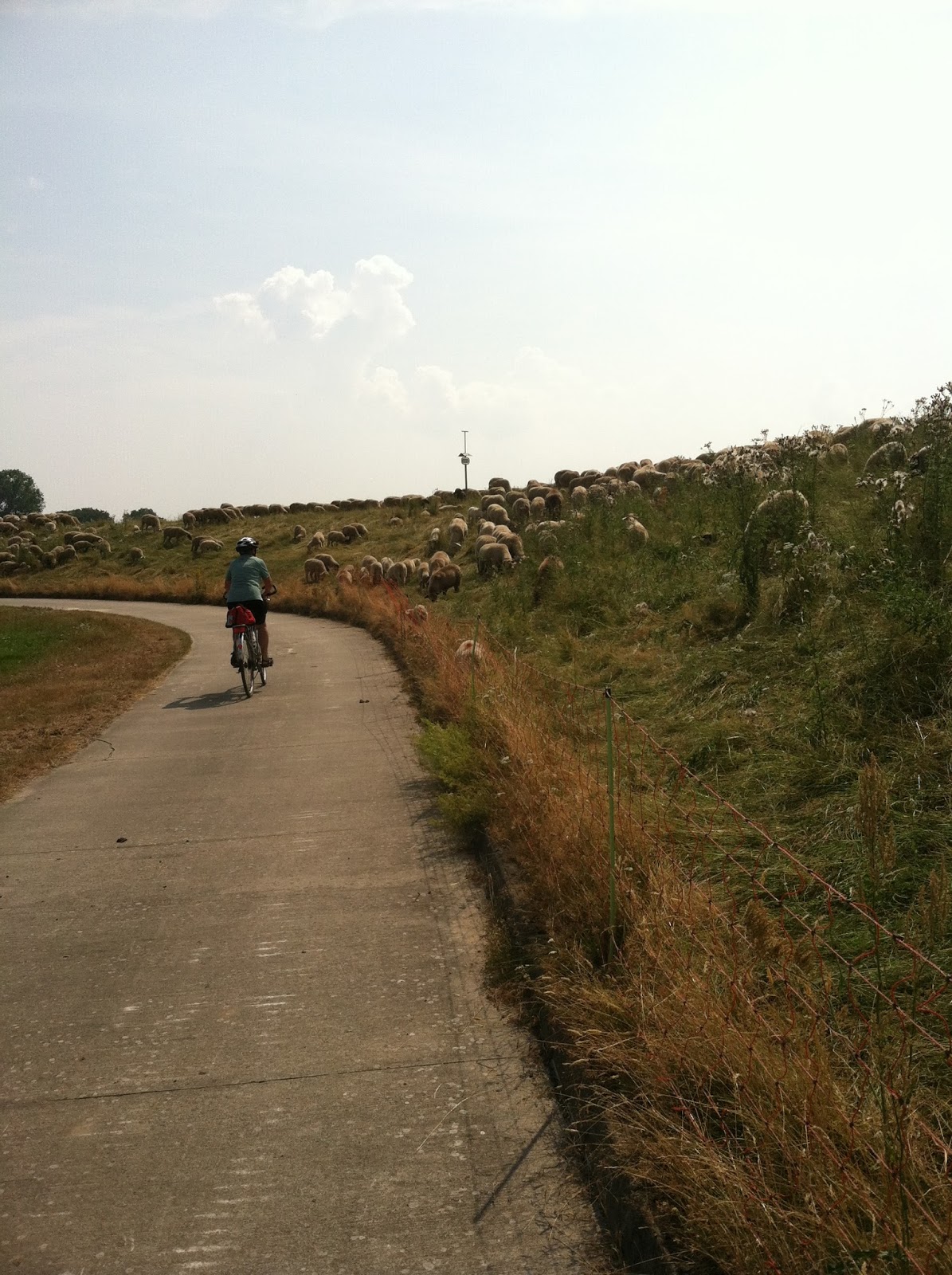

Later we saw a large flock being moved.  There were four dogs, none of which looked like the kind of border collies familiar to us but all very skilled at their jobs.

Because the Elbe served as the border there are few bridges and most traffic crosses on ferries.  We took a ferry back onto the West side visiting the village of New Bleckede.


The sign at the crossing is an example of the fact that the border did not open all at once.  The date is six days later than on the sign we saw when first passing into the East.  The crossing was fun and slightly suspenseful.  This huge truck appeared at the ferry slip not knowing whether he would be loaded and knowing that the ferry would save him 70 kilometers of driving.  He was permitted on and took of most of the available vehicle space.


The ferry also did a booming business in tractors and hay bales.


An empty tractor and trailer loaded when we disembarked and this one arrived as we waited for our return trip.  

Bleckede was a town full of charming old house like this very tipsy one.  


I was charmed, also, by this fellow peering over a wall.  

Our night was spent in one of the huge old barns typical of the area.  It had been beautifully  renovated as a hotel intended to be accessible to the handicapped.  The rooms and bathrooms were huge-- the shower had no enclosure, just a drain in the floor-- designed to be used by someone in a wheelchair.   Money had run out, however, so progress was stalled-- most apparently because the entrance to the elevator was blocked by a piece of plywood.  We were told it was out of order but it was pretty clear that it didn't even exist.  

In the meantime they were hosting a large number of ambulatory senior citizens.  They were people who lived on their own but had gotten together for a multi-day excursion.  Because they felt it was too hot to be sightseeing, they were playing cards on the patio.  About four they started with coffee and "kuchen" and about six moved on to beer.  My friend Ingrid said that Germans at home typically eat a full hot lunch, coffee and cake in the afternoon and cold meat, cheese and bread for dinner.  

It was clear that the place had been located directly on the border patrol road.  The road in front of the hotel was paved but dead ended shortly thereafter trailing off into the kind of divided concrete blocks that had been used on the border.  

There was a great stork nest nearby.  Liz had a better camera and got better pictures of storks than I did.  I will try to swap this one out eventually.  Storks are considered good luck and many nesting poles like this one are erected for them.  The sitting storks we saw were probably young ones, waiting for their parents to bring food.  When a nest appears empty it is often because they are deep enough to hide the birds when they are lying down.  


This is an example of German commitment to solar power.  Completely covered roofs like this one are a common sight.  
Continue to Part 7

Thursday, August 8, 2013

Busy in Boisenburg (Germany Part 5)

(Start Reading at Part 1)

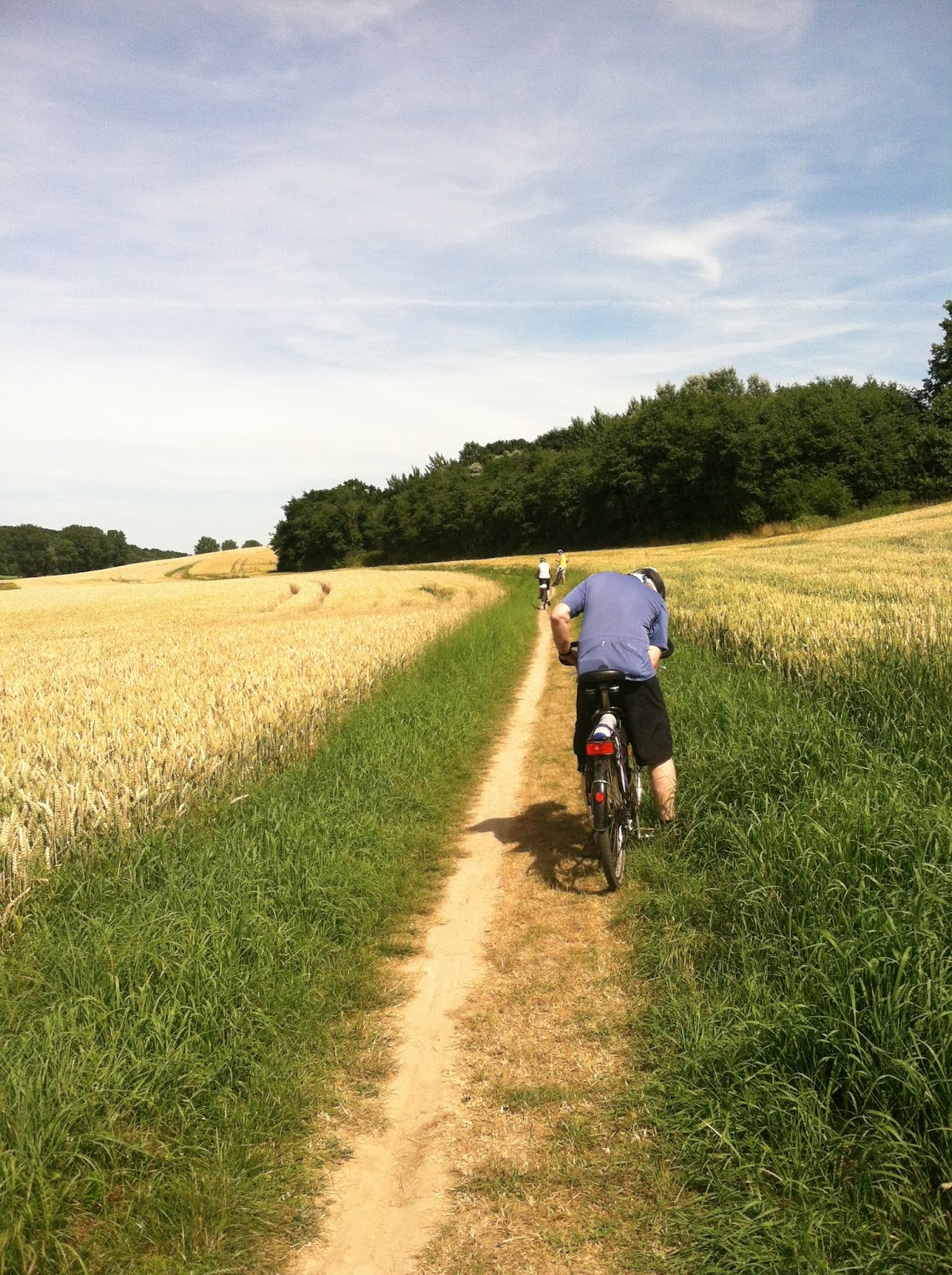
The day began with an idyllic ride on this forest road-- cars were apparently not excluded but none passed us for hours.  I knew we were in the area of the east west border and wondered if this paved road was part of the system but was never clear on that.  When we left the forest, we were in an agricultural area, then came upon an open air museum with all the elements of  border fence security as it was fully developed by the 1980's.

A five kilometer border zone was first established in 1952.  Persons living close to the border or deemed politically unreliable were moved out of this zone but farming was continued where possible.  Persons authorized to enter the zone were strictly controlled and were expected to contribute to border security.  In the beginning there was no fence, just gates at crossroads.  As the system developed a signal fence was installed.  The fence included strands of electrified wire that activated an alarm if cut or pulled.


Layers of complexity were added over the years.  Mining of the borders began in 1966 but mines were removed in 1984 in the face of international condemnation.  "Hedgehog" strips were designed to ruin vehicle tires, devices were added to the fences to shoot shrapnel, dogs on long runs patrolled some sections and after the mines were removed, the border included and anti-vehicle ditch that sloped down and ended in a brick or concrete wall.  


This type of small observation tower was common but has mostly disappeared.  It was designed for two guards, had rifle slots and a can toilet.  


Once we learned to recognize the distinctive type of fence wire used in the border, we sometimes saw recycled bits like this.  


We several times cycled on concrete paths but didn't realize until later that they were remnants of the old border road.   


Our destination for the day was Boizenburg, a town just a few kilometers inside the east west border.  Fittingly, the hotel where we stayed was renovated from a facility that housed members of the Stasi, the "Ministry for State Security."  Our ride was short enough that we saddled up after a short break and rode into the city itself.  There we got our first view of the Elbe since Hamburg-- a pastoral scene wildly different from the forest of cranes and ships we had seen in the harbor.  


While John explored the town with Ingrid and Bill, I rode off with Liz and Rick to look at another outdoor museum.  This was "Checkpoint Harry", an observation tower and associated building that has now been turned into a restaurant by that same name.  


Our hotel restaurant featured many dishes made with kangaroo meat but none of us availed ourselves of it.  They also keep ostriches-- not for eating but for eggs and we were given complimentary glasses of ostrich egg liqueur when our meal was finished.   It was lovely and sweet and went down very well.  

Continue to Part 6

Wednesday, August 7, 2013

On to Zarrentin (Germany Part 4)

(Start Reading at Part 1)
Julius Langhans Family

From left to right:  Julius Langhans and his wife Christianna.  The baby is Carl Langhans.  Standing by their parents are the twins, Edward and Hannah.  Sitting on the ground are Ernest, Herman, and Martin.  The picture is probably taken in East Otto, New York.  Herman, John's grandfather, was born 3 May 1880 in Dargow, Germany and the family arrived in New York in 1884.  Baby Carl was born in September 1890 so the picture is perhaps 1891.  


John Frederick Langhans, son of Meier Frederick Langhans and grandson of Herman Frederick Langhans at the bus stop in Dargow, July 2013.  The first Langhans descendant to return to Dargow.

It was a short day of riding even with our planned diversions so we spent some time exploring the churches of Lubeck before heading out of town.  That was one of our least memorable stretches of riding-- on city streets for some time, finally out into the suburbs, roundabout, another roundabout, finally over the autobahn and relief-- we turned right onto a shady green lane and ideal cycling.  Our route led us past more wheat and in one field we were able to watch the gigantic thresher chomping through the rows and spitting chaff out one end and kernels into a truck lumbering slowly alongside.  Sadly I was so fascinated with watching that I did not take a picture!  Eventually we arrived at the Ratzeburg Lake and turned onto a bumpy lakeside path.  We had an informal lunch in the Ratzeburg Market Square and headed out again ready to make the short diversion to Dargow which lay slightly off our route.

The area in which we were riding is called the "Lakes of Lauenberg" and includes about forty lakes.  Our ride along the shores of the Ratzeburg Lake was just the beginning.  We were on trailside paths and hiking paths for several kilometers before turning toward Dargow.  Dargow is small, not much more than a crossroads.  No house that we saw appeared old-- it was hard to get a sense of what the place was like a century ago.  There are now no telephone listings for Langhans in Dargow although there are listings in nearly Mustin, Sterley and Hollenbeck; all villages associated with the family.


Touring around the small village we did see this one family association.  An early Langhans, Joachim Hartwig Langhans married a Dorothea Eggert.  At this place there was high viewing platform open to the public.  We all climbed up for the great views.  

John and Dereka - viewing tower in Dargow, Germany

Then it was off to Seedorf, the town in which Dargow residents went to church and from whose parish registers I had learned the details about John's ancestry.  Seedorf was back on the Germany Cycling Tours route. 


The Church in Seedorf


 I had little hope for the church and cemetery because most burials in Europe are not perpetual.  The stone and plot are maintained as long as there is family to pay but at some time the bones are exhumed and the grave is reused.  Imagine our surprise, therefore, when we stopped at the church, started up the walk and right away saw a large marker headed  Dem andenken unseres sohnes  Johannes Langhans.  (The remains of our son).  The position of the marker vis a vis the sun was terrible and made it difficult to take a picture but it was very legible to the eye. Both a memorial and a grave marker, it honored a Johannes born in 1892 who died in Russia in 1915 as well as his parents, Johannes and Catharina.  John's grandfather Herman Langhans was born in 1880, about twelve years earlier than the Johannes who died on the battlefield and could certainly be a cousin.  The logical connection fails, however, because it appears that the older Johannes is unlikely to be a brother of Julius Langhans who was born 29 years earlier in 1839. 


 In Salt Lake City I copied many pages of the Seedorf parish registers and I will examine them again but since I don't have all the pages it will be a matter of great good luck if I find the 1868 Johannes.  This is what the parish registers look like.  It takes a bit but one can get accustomed to the handwriting and pick out the relevent entries.  Time for another trip to SLC??  I have been looking for an excuse but this seems a flimsy one.  

Leaving Seedorf we headed for our evening's destination and before long we came across our first crossing into the former DDR-- East Germany.  


The Berlin Wall was opened on 9 November 1989 and the "Iron Curtain" crossings began about the same time and continued for several weeks.  We passed several similar signs, each with different dates.  Existing crossings were opened immediately and over time new crossings were established, connecting communities that had been separated for more than forty years.  We learned and thought about the border and the different regimes frequently over the next few days of the ride and I will write more but this post is nearly long enough for now.  

Entering Zarrentin our instructions led us on a sightseeing diversion about which we were too tired to care and that was difficult to follow.  We bumbled around hither and yon eventually ending up on the same street where we had entered the town and arrived at our hotel about 5:30 to find that our luggage had not arrived!  Catastrophe!  It was our routine to shower and rest before seeking a refreshing beverage but now the beverage had to come first.  A pretty and nice waitress was ready to supply beer and wine and as time dragged on with no luggage, one drink led to another.  Finally our bags arrived, we showered and had dinner.  With it appeared the specialty of the area, courtesy of the chef.


This was fat, mixed with caramelized onions and apples.  Was it chicken, pork?  I didn't want to know but in my drunken state, open to new experiences and pushing aside the fact that I was a vegetarian, I ate it!  It was not horrible and I was not the only one who ate it-- we finished all the bread but not quite all the stuff.  Then, general jollity so prevailed that we abandoned all caution and ordered large ice creams all around.


Continue to Part 5

Tuesday, August 6, 2013

From Hamburg to Lubeck (Germany Part 3)

(Start Reading at Part 1)

And so we started the ride!  Our hotel was near the airport and at the intersection of two busy streets but less than 1/2 mile of street riding took us off the road and onto a bike path, mostly through the wooded "Alster Park".  From the beginning we had trouble with the directions-- they had clearly been translated from German into English and were not always crystal clear.

"After a further green bridge you turn left.  After 200 m you change the river bank again and bear right after the bridge.  400 m after it you cross over an auburn and bear on the right path after it.  After 600 m you pass rightwards over a large green bridge."

The first day was nearly four pages of single spaced instructions like these and we often stopped to determine our direction.  The riding was lovely, however, and the weather pleasant.  The forested and meandering Alster Park is much used by Hamburg residents-- many of whom were walking dogs.  We learned that German dogs may be licensed to be off leash if they are under voice command and the behavior of the dogs along the way was truly impressive.  A hand signal from the owner was enough to keep them sitting quiet and still at the side of the trail and not once were we barked at or menaced in any way.


For a few of the first miles we were on the famous Pilgrim Path to Santiago de Compostela.


But we we were not always in the woods.  This is wheat of which we saw a great deal.


Our destination was Lubeck, "The City of Seven Spires".  The Holsten Gate is called one of the most famous buildings in Europe.  In 1863 there was a move by persons in the city council to demolish the gate-- it was in poor repair and "impeded traffic".  By a single vote the building was saved and in turn has proven its worth as a tourist attraction.


Another view with Dereka and Ingrid in the foreground.


The old city side of the Holsten Gate.


We ate dinner outside at a nice restaurant on the river bank across from this charming row of old buildings.

 On 28 March 1942 Lubeck became the first German city of be attacked by the RAF.  Four thousand tons of bombs were dropped by 234 bombers and the devastation was immense.  Three hundred people died, 780 were injured and 15,000 lost their homes.  Goebbels is quoted as saying "Thank God it is a North German population which on the whole is much tougher than the Germans in the South and South east".  Under wartime and postwar conditions it took until 1948 to simply clear the rubble.  Following that, the city was rebuilt.  As in many German cities the rebuilding continues today.

File:Germany Luebeck St Mary melted bells.jpg

The melted bells of St. Mary's church have been left as a memorial.


Three Catholic priests and one Evengelical Lutheran Minister were arrested after the air raid, found guilty of questioning the Nazi regime and executed by guillotine on 10 November 1943.  All four were beatified by the Catholic Church in 2011.
Continue to Part 4

Monday, August 5, 2013

To Hamburg by Train (Germany Part 2)

(Start Reading at Part 1)

The day after our bicycle ride to Freiburg, we rose early to get the train to Hamburg.  It was an ICE train-- went very fast, windows were filthy, seats uncomfortable-- lots for me to be grumpy about.  To top it off, the strap on my bag broke just as we exited the Hamburg subway and I had to schlump along like a hobo to the hotel.  All was remedied by a good dinner at the Rotbuche (Red Beech) restaurant near the hotel.  After dinner John, Ingrid and Bill went back to the city while I reconnected with our friends Rick and Liz and had a glass of wine to further soothe away the trials of the train.

We were not due to meet Steve the bicycle man until 6:00 in the evening so sightseeing was in order and our day was fun, full and informative.  We climbed another church tower-- always a kick for me even though I have to drag myself panting and groaning up many flights of stairs-- in this case getting a few more stars in my crown because there was an elevator that I did not take!

Hamburg is the second largest port in Europe (after Rotterdam) and the tenth largest worldwide.  Scores of container ships like the one pictured come up the Elbe to Hamburg to be unloaded.    All six of us decided to take a river trip to see the ships and docks at close hand.  The river tour was great and took us into one of the side channels as well as up and down the main part of the river.


Not many years ago cargo shipping needed hundreds of dock workers to load and unload ships.  Now a single computer operator can do the same work in a fraction of the time.

The river area was crowded with tourists and "living" statues were doing a brisk business.


More impressive, however, was this group of three.  We had seen them dressing and making up earlier in the day but missed the actual set up.  All three figures are suspended motionless-- the woman on the left (not clearly seen in the photo) is sitting on air as is the man in the front.


This is the most impressive example of such artistry that I have ever seen.  I am sorry that I didn't get a better picture.


John and I finished out the day with a trip to the BallinStadt Auswanderwelt-- the emigrants museum. The museum is located inside five buildings built to house persons while they were waiting for clearance to leave Germany.  John's entire ancestry is German and most of his immigrant ancestors sailed from Hamburg. They were:

Sophie Mirow, a 42 year old widow, sailed on the Allemania arriving in New York in October 1872.  With her were sons Friederich, Edward (John's great grandfather), Carl and daughter Louise.

Herman Henkel and his wife Pauline with John's grandmother Anna and two other children sailed on the Cimbria and arrived in New York on 24 August 1881.  Anna, the eldest, was three years, Carl was two and baby Max was three months.

Julius Langhans and his wife Christina traveled on the Moravia, arriving in New York on 6 May 1884.  With them were Julius' four children by his first and deceased wife, John's grandfather Herman, age three and Ernest, one year.

The exception is the couple Philippina and Carl Graf who sailed from Le Havre on the ship Rochambeau, arriving in New York in May of 1859.  They were the earliest of John's German ancestors to come to the U.S.  They were young and as yet had no children.

It turns out, however, that the facility housing the museum was built between 1898 and 1901, years after John's ancestors passed through Hamburg so was not directly relevant to  the experience they had in Hamburg.

 The surprise for us was that the museum featured the famous ship Imperator, the "ship of dreams".  It was the Imperator on which my father, Marshall K. Smith, emigrated from England to Massachusetts in 1920. This ship was an ocean liner built for the Hamburg American Line.  She was built in 1912 and was 24 feet longer than the Titanic. She was launched in 1912, just five weeks after the Titanic disaster.   In 1913 she was the largest passenger liner in the world but was soon surpassed by the 44 foot longer ship Leviathan.  


On her maiden voyage Imperator carried 859 in first class, 647 in second class, 648 in third class, 1495 in steerage and 1332 crew for a total of 4986.  Service was interrupted in 1914 with the outbreak of World War I.  The Germans decided that the ship was too valuable to risk in wartime, so was laid up in Hamburg for the next four years.  In 1918 after the armistice, the ship was taken over by the U.S. military.  In three voyages Imperator returned over 25,000 soldiers, nurses and civilians from France to the U.S. In 1919 the ship was handed over to the British Cunard Line and in 1921 was renamed Berengaria. 

When telling the little he remembered about his voyage to America, my father always said that he sailed on the renowned Berengaria, the pride of the Cunard fleet.  When I found the passenger list for their arrival in August of 1920, however, the vessel was called Imperator.  I was puzzled about this briefly but with a little research learned that it was the same ship.  British pride in Cunard apparently trumped the fact that in 1920 the ship was operating under the German name.  It is interesting to note that while the museum exhibit focused majorly on the Imperator, the history of the ship after 1918 was not mentioned.  I am guessing that Robert and Mary Smith, my grandparents, traveled second or third class.  Some of the pages of the pasenger list were labeled "Steerage Passengers Only" and the page on which they were listed did not have that notation.

Our day ended with the arrival of our bicycles and another dinner at the Rotburche.


The bicycles and Steve the bicycle man outside Kochs Hotel, Hamburg.

Continue to Part 3

Sunday, August 4, 2013

Arrival in Zurich and Munsingen (Germany Part 1)


Our trip actually began in Zurich, Switzerland where we spent two days with my English cousin, Rob Walsh.  Suffering from jet lag and having been to Zurich before, I was very content to spend our visit talking and eating with a bit of walking around town.

Proud genealogical researcher that I am, I was humbled to find that Rob has learned more about my English grandfather than I have ever been able to do.   His name was Robert Leslie Smith and he was the older brother of Rob's grandfather, Alfred Edward Smith.  "Alf" was the younger by 14 years and apparently had had little contact with "Leslie." My grandfather left his wife and family in Turner's Falls, Massachusetts when my own father was young and was not seen again.  I was told by an English military "expert" at an NGS conference that there were no available records for British solders unless they had died.  Because he eventually went back to England, I had given up on researching him.  Imagine my surprise when Rob showed me the complete military file for Robert Leslie and other bits of information as well.  The information therein, mostly about his health (or lack thereof) will be treated in a separate blog post.

After two nights with Rob and two delicious and healthful dinners with Rob and Peter, we were off to Munsingen, Germany, a small village near Freiburg where our friends Ingrid and Bill have a home.  We traveled in style, Rob having graciously offered to drive us and still sleepy, I missed most of the ride. Upon arrival I was immediately mystified and intrigued by the little parking garage of which one space is theirs.  


Turns out that each of the space holders has a key that raises or lowers the spaces as necessary.  Extraordinary but not uncommon in German villages where space is very limited.

Bill and Ingrid have four bicycles and refreshed by my nap, I was ready for our first  ride.  Munsingen is in a grape growing and agricultural area with a hill called the Tuniberg rising up from the flatter lowlands.  We rode first through fields of asparagus and up into the vineyards  laced with an intricate network of roads that serve double duty as bicycle paths.  What a great ride-- and not on my tough little road bike but upright on a bike with a big cushy seat, wide comfortable handlebars and comfy fat tires.  True, we did need to walk up several hills but all the better to observe the scenery, I always say!


The next day we took a longer ride, part of our route being along the Rhine with France on the opposite bank.  The picture is of John and Ingrid resting-- it was a hot day-- the first of what would turn out to be a period of unseasonably hot and dry weather in Germany.


 Our destination was a medieval village perched on a hill with a ruined castle and narrow twisted cobblestone streets.  The village had several photographic murals illustrating what the village looked like a century ago-- each was placed so that one could view the picture and the real present  at the same time.  They were extremely informative of the contrast between the beflowered and freshly painted houses of today and the ungentrified scenes of yesteryear.  


On our third day in Munsingham we rode bicycles to Freiburg, a city about 15 kilometers distant.  
We climbed the Munster-- it is in a constant state of restoration being sandstone-- and had lunch in the marketplace before the ride back.  


Freiburg is famous for the gargoyles and the most famous of all is this one-- I couldn't get a picture myself but easily found one on the internet.  Someone in the 15th century had a point to make or a childish sense of humor.  I wanted to buy a postcard for my grandson but John's delicate sensibilities would not permit it.  


On a more somber note it was in Freiburg that we first saw these small street memorials embedded in the sidewalk.  Three hundred Jews were taken from the city during the holocaust, most of whom died in concentration camps.  There is a plaque in the city that reads Too many people looked away back then, too few resisted.  This must not and will not happen again.  
Continue to Part 2

Sunday, July 7, 2013

Bicycling in Michigan - June 2013; Part 4

(Note: This is Part 4 of a four part series.  For Part 1 click here.)

Leaving Cedarville on another cool gray morning, we headed off to St. Ignace.  Riding with John and some miles into the ride (about which I can remember little else), we suddenly rode into a thicket of flies.  Thinking it was a momentary thing, I concentrated on keeping my mouth closed-- past experience being a guide to the undesirability of swallowing bugs of any kind.  I noticed that there were hundreds of the same insects dead on the shoulder of the road and wondered what was killing them.  Then I noticed that many of the flying ones were in mating pairs and that I could see single flies plummeting to earth for no apparent reason.  John suggested that these were mayflies and later research confirmed this.

Mayfly "hatches" are becoming more numerous in recent years and attest to the growing health of large bodies of water such as the Great Lakes, particularly Lake Erie (although we were cycling along Lake Huron).  The water stage lasts about a year but the adult stage can be as short as an hour.  The adults have only one mission and that is to mate and if female, to lay eggs.  Our experience with them was more interesting than annoying-- they don't bite or sting and judging from pictures like the one below, the numbers we saw were actually quite small.  This is a guy blowing dead mayflies off his deck.

Mayflies on Marblehead Ohio


Our riding route brought us back to St. Ignace, the town at the northern end of the Mackinac Bridge and the location of the ferry that was to bring us to Mackinac Island.  Wow!  What a place!  Touristy for sure but we were ready for some tourist whoopee after the woods and mosquitoes of the U.P.  A fast boat ride and we were in another world.

The mingled smells of fudge and horse manure (I like both, fortunately-- or perhaps unfortunately in case of the fudge)  greeted us as we walked from the ferry dock onto the crowded Main Street.  Mackinac is car free  and has been since 1901 when an early "horseless carriage" terrified some real horses and caused injuries.  Upon asking I learned that there were 450 horses on the island as of our visit with 50 more to come when the season heated up.  One can join a carriage ride, rent a horse and carriage or simply rent a riding horse.  Island residents have barns, horses, carriages and etc.  There are carriage taxis and heavy horse drays (like flatbed trucks).  All of those horses poop!  Cleaning up after them is a major source of jobs on the island-- probably more people sweeping up poop than making fudge.  The Main Street is continually swept and power washed every night.  Mackinac sees 15,000 day trippers in high season and although we weren't quite there yet, there must have been 10,000.  Many of them rent bicycles, tandems, bikes with baby and dog carriers and teeter off down the street dodging pedestrians, horses, carriages and other bicyclists-- and not always successfully.  One of our group, standing still on her bicycle, was hit head on by a young man piloting a tandem with his adoring girlfriend behind-- perhaps not so adoring when his lack of skill was so clearly demonstrated and our victim was sufficiently injured to go to the island medical facility.


This is a picture of the Mackinac Island Airport with a "taxi" waiting for customers.


A three horse team gets watered  and sprayed with citronella while the passengers are viewing Arch Rock.    The horses work four hour shifts per day and stay in the same team and with the same driver as much as possible.


Arch Rock with the water far below.  Not really visible in the picture but we could see that visitors had made hearts and initials in the shallow water with carefully arranged stones.


There is no shortage of composting materials on the Island and beautiful gardens attest.


Lots of beautiful Victorian houses.

John and I rode the eight mile trail around the perimeter of the Island on the first day-- a really lovely ride despite my many warning cries as people rode or stepped into my path).  Delightfully our gray and gloomy day metamorphosed into sunshine and blue skies and away from the Main Street the natural beauty of the island comes through. The next day, we took the island bicycle map and rode nearly every possible road in the interior-- up past the very grand "Grand Hotel" where it costs $10.00 to get entry to the porch and  $40.00 for a buffet lunch-- to Arch Rock, West Bluff, Sugarloaf, the beautiful cemetery, the British Landing site-- we saw it all.  Tourists are called "fudgies" and we proved the point by purchasing three kinds (to take home to our kids, hah!) and sadly boarded the ferry for our trip back to Mackinaw City and our last night together as a group.

We had a reasonable dinner at a rather fantastic restaurant called "Nonna Lisa".  It is supposed to be Italian but the decor is log cabin rustic furnished with scores of stuffed animals. Standard North American forest beasts like moose, deer and wolverines as well as more exotic creatures including lions and tigers.  All snarling and snapping in their death throes and not delightful for a "veggie".  Still it was fun and slightly nostalgic to know it was our last dinner together-- as always our small group had bonded in the way that ship passengers are said to do.   Soon John and I were back in our "Lighthouse Room" at the Lamplighter Motel where we had stayed the second night of our ride and as always early to bed and a good sleep.

In the morning it was pouring and none of us were eager to ride but Mother Nature smiled at us and the rain let up long enough for our ride to the breakfast restaurant.  It poured again while we were eating but stopped when we were ready to push off.  There had been some debate about the route options.  We had ridden to Mac City through the "Tunnel of Trees" but the atmospheric conditions had been so poor that we didn't get the benefit of the scenery.  Some wanted to return that same way rather than the shorter and more direct route.  John and I chose the latter, however,  and off we went only to find that the scenery on that route was truly delightful-- much more appealing to us than the closed in tree route-- lots of open vistas and several significant hills giving us reasonable climbs up and lovely swooping rides down.  We also had the fun of meeting a solo cross country rider named Sarah-- we rode with her briefly before she left us in the dust-- despite being heavily loaded with four panniers.  Because she took the longer route we met her again while we were lunching in Harbor Springs and we had the fun of being included in her blog http://honoringmycompass.blogspot.com/2013/06/day-29-tree-tunnels-bona-fide-tourists.html.

After lunch we located the correct route along lovely Beach Street that we had missed on the first leg of the trip and soon we were back in Petoskey and at our car.  Sadly, except for riding with Susan and seeing Gaylin and Mike who had gotten a ride because Gaylin was suffering from a bad cold, we had ridden out ahead of the others and did not make a proper goodbye.  So to make up for it now and for those who have troubled to read this far in my narrative-- here it is.  Karen and Suzanne, Jane and Tom, Peggy, Linda, Bob and, of course, Gillian!  You were a great group to ride with and we wouldn't have missed it for anything.    Safe riding all!

Part 1
Part 2
Part 3